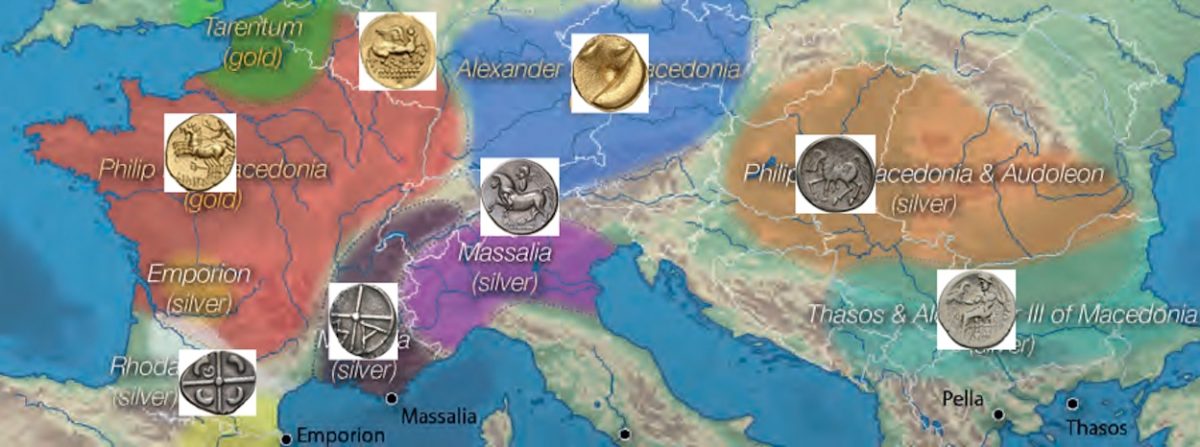
Online Celtic Coinage goes live
The prototype online portal for Celtic coinage is now online: https://occ.dainst.org/. Online Celtic Coinage (OCC) follows the paradigm of linked open data of portals such as Online Coins of the Roman Empire (OCRE), and employs the Cultural Heritage Management System Dédalo that powers the prize-winning portal Moneda Iberica. Initially developed within the scope of the…
A new blog for De Retibus Nummorum
The project “de retibus nummorum. Die Vernetzung der spätkeltischen Welt am Beispiel der Münzwirtschaft” (de re num), financed by the Deutsche Forschungsgemeinschaft has set up a blog on Hypotheses: https://derenum.hypotheses.org. The project, which is based at Leipzig University, investigates the emergence and development of the Celtic monetary economy from the 3rd to 1st century BC. It…
Launching a consortium for an Online Celtic Coinage portal
A big Thank You! to the PROCOPEplus programme of the Ambassade de France en Allemagne and the Deutscher Akademischer Austauschdienst for funding our workshop in Orléans on 30/31 January 2025. Following a preliminary online meeting in October 2024, 17 participants from France, Germany, the Czech Republic, Guernsey, Switzerland and the United Kingdom met for two…

ClaReNet becomes DeReNum
Building on the results of the ClaReNet project, from 1st January 2025 a new research project called ‘De retibus nummorum’ will investigate the emergence and development of the Celtic monetary economy from the 3rd to 1st century BC. Type and die studies, supported by methods of artificial intelligence such as deep learning, and feature detection…
The project ClaReNet ends
Funded by the German Federal Ministry of Education and Research for three years, the project ClaReNet: Classifications and Representation for Networks, ended on January 31st 2024. You can read more about ClaReNet on the project blog https://clarenet.hypotheses.org. A report on our work on the use of convolutional neural networks for the classification of coinages has…

New publication on the application of AI for analysing a Celtic coin hoard
Read how we supported Philip de Jersey in his “lifetime’s” work analysing the massive Le Câtillon II hoard! Deligio. Ch., / Tolle, K. / Wigg-Wolf, D., Supporting the analysis of a large coin hoard with AI-based methods. In: CAA2023 Conference Proceedings (PCI Archaeology 2024) <doi: 10.5281/zenodo.11187474>. In the project “Classifications and Representations for Networks: From…
Meeting of the Iron Age Working Group to be funded by PROCOPEplus
We are delighted to announce that we have received funding for a meeting of the Iron Age Working Group to be held in Orléans on 30/31 January 2024 from the Franco-German cooperation programme PROCOPEplus. The coodinators are S. Nieto-Pelletier (IRAMAT, UMR 7065 CNRS-univ. Orléans), K. Tolle (Goethe University Frankfurt, Big Data Lab) and D. Wigg-Wolf…

ClaReNet project: Virtual workshop on Linked Open Data for Celtic Coinages
On June 21, 2021, the ClaReNet project organised a virtual workshop to discuss the particular challenges of modeling data on Celtic coins and to lay the first foundations for a common reference model for a virtual union catalogue “Online Celtic Coinage”. In addition to the project members, fifteen colleagues from Germany, France, Great Britain, Switzerland…
CELTIC COIN INDEX DIGITAL (CCID) goes live!
The School of Archaeology, University of Oxford, is pleased to announce the launch of the website: Celtic Coin Index Digital (CCID). The CCID is an online archive that provides access to one of the world’s largest datasets of Iron Age coins in Britain: the Celtic Coin Index (CCI). The CCI has been housed in the…
Ancient British Coinage goes online!
Iron Age Coins In Britain (IACB) brings Linked Open Data to British Celtic Coinage Ancient British Coins (ABC) is the most comprehensive reference book for the typology of the Iron Age coins of Britain. ABC catalogues 999 types of coins found in Britain from around the early to mid-2nd century BC through the 1st century AD.…
Something went wrong. Please refresh the page and/or try again.
 Online Celtic Coinage